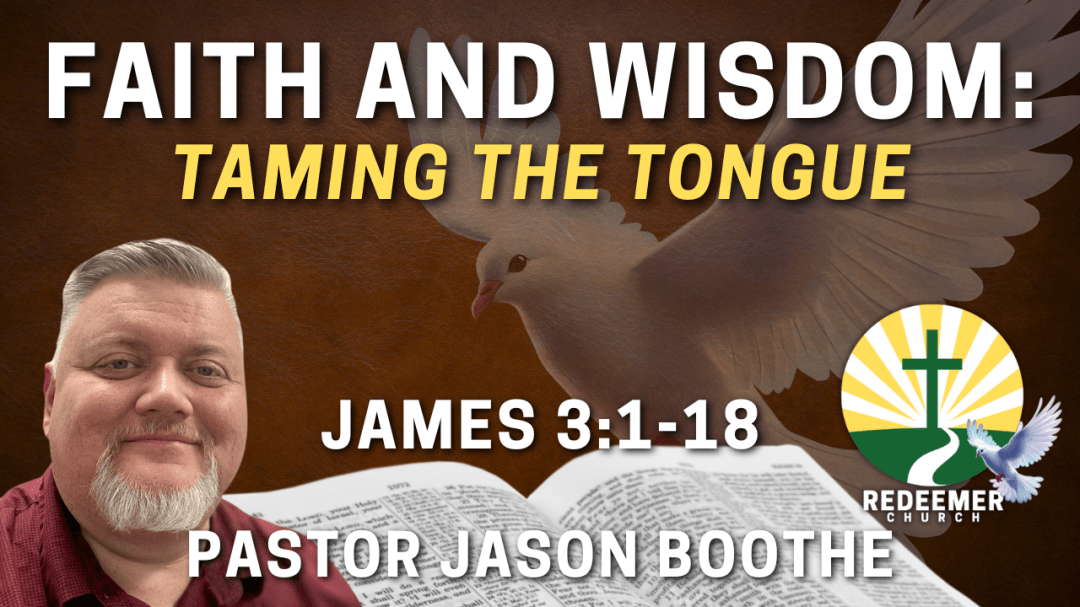
The Epistle of James is one of the most practical and challenging books in all of Scripture. It is a call to live out genuine faith in the light of God’s grace through Christ. James teaches us that faith without loving action is of little use to anyone—our profession must be displayed in obedience, humility, and love.
In the first two chapters of his letter, James showed us that faith endures trials with joy and that faith without works is ‘dead,’ or useless to those around us. Now, in chapter 3, he turns our attention to an area that touches every believer—the words we speak.
Jesus once said, “Out of the abundance of the heart the mouth speaks” (Matthew 12:34). Our speech is a reflection of our thought life. What flows from our lips reveals what fills our hearts. Often, the heart can be a dark and lonely place! In this passage, James exposes both the danger and the potential of the tongue—and shows that only the “wisdom from above” can empower and motivate us to edify, encourage, and love with our words!
1. The Tongue’s Power to Direct
James 3:1–5a
James begins with a sober warning to those who teach God’s Word: “Not many of you should become teachers, my brothers, for you know that we who teach will be judged with greater strictness.”
Teachers shape lives through their words. Their speech directs others, just as a small bit guides a horse or a rudder steers a great ship. The same is true of every believer. Our words are steering our lives and influencing those around us.
Parents guide their homes through what they say. Church members build up or tear down the body with their speech. Pastors lead congregations by proclaiming truth or error. Words matter. They direct hearts either toward God or away from Him.
2. The Tongue’s Power to Destroy
James 3:5b–8
James doesn’t soften his words here: “The tongue is a fire, a world of unrighteousness… set on fire by hell.”
A single spark can ignite a forest fire, and a single word can ignite destruction. Gossip ruins friendships. Lies destroy testimonies. Slander divides churches. James says plainly that “no human being can tame the tongue.”
This is not just a behavioral issue: it’s a heart issue. Only the regenerating work of the Holy Spirit can transform our speech. We must cry with the Psalmist, “Create in me a clean heart, O God, and renew a right spirit within me” (Psalm 51:10).
Because of Christ’s finished work, we can rest in His grace even as we strive against our sinful tendencies. The Gospel gives us both the assurance of forgiveness and the motivation to pursue godly truth and beauty in how we speak.
3. The Tongue’s Power to Reveal
James 3:9–12
James goes deeper: the tongue not only directs and destroys—it reveals.
With our words, we bless God, and with the same lips, we curse people made in His image. James calls out the hypocrisy of such double speech. “My brothers, these things ought not to be so.”
Just as a spring cannot produce both fresh and salt water, a heart renewed by Christ should concern itself with blessing and building up the brothers. Our speech exposes whether grace or bitterness within us rules the day!
Jesus said it best: “A good man brings good things out of the good stored up in his heart… for out of the abundance of the heart his mouth speaks” (Luke 6:45).
4. The Wisdom from Above
James 3:13–18
After showing the danger of the tongue, James turns our focus to the source of true control—heavenly wisdom.
There is earthly wisdom, which is self-centered, proud, and destructive. And there is wisdom from above, which is pure, peaceable, gentle, open to reason, full of mercy, impartial, and sincere.
True wisdom is not merely intellectual—it is moral and spiritual. It is the wisdom that flows from a heart forgiven by Christ. Such wisdom produces peace and righteousness in our relationships and our words.
Paul echoes this same truth: “Let your speech always be gracious, seasoned with salt” (Colossians 4:6). Only by the Spirit’s power can we learn to speak life instead of death, blessing instead of cursing.
Conclusion: A Tongue Informed by Grace
The tongue is small but mighty—capable of directing, destroying, and revealing. Yet the hope for our speech and our souls is found in the wisdom that comes from above.
Jesus Christ, the One who never sinned in word or deed (1 Peter 2:22), has redeemed us and sanctifies our hearts by His Spirit. Because of Him, our faith can be displayed not only in our works but also in our words.
So let us pray with the Psalmist:
“Let the words of my mouth and the meditation of my heart
be acceptable in Your sight, O Lord, my rock and my redeemer.” (Psalm 19:14)
Soli Deo Gloria.

Jason Boothe serves as a Pastor at Redeemer Church of Piketon, Ohio.
Discover more from Redeemer Church
Subscribe to get the latest posts sent to your email.

 Redeemer Church