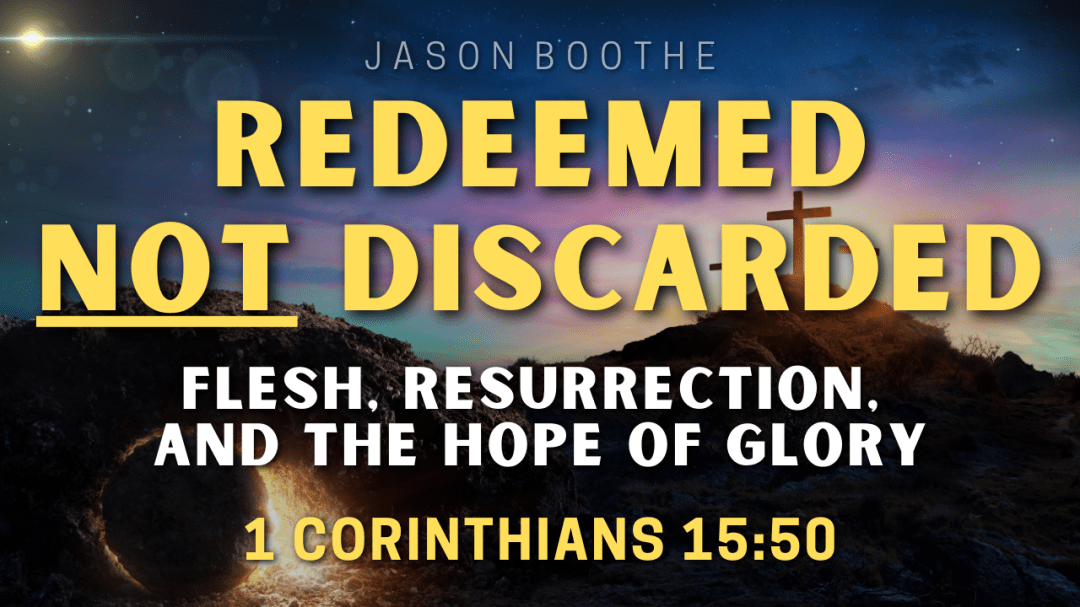
I tell you this, brothers: flesh and blood cannot inherit the kingdom of God, nor does the perishable inherit the imperishable. I Corinthians 15:50
At first hearing, Paul’s words can sound harsh. Do they mean that human bodies have no place in God’s eternal kingdom? That everything physical must be discarded forever? Or is Paul drawing a careful distinction between humanity as it exists under the curse of sin and humanity as it is made new through Christ?
When read in light of the whole of Scripture, the answer becomes clear. Paul is not rejecting the body. He is explaining why the body, as it now exists in its fallen condition, must be transformed before it can share in eternal glory.
From beginning to end, the Bible tells one unfolding story of complete redemption. When Adam fell, the consequences reached far beyond his own heart. Adam stood as the representative head of humanity and of creation itself. Because of his sin, God declared, “cursed is the ground because of you” (Genesis 3:17). Thorns and thistles would now spring up, and human life would be marked by toil, frustration, and death.
Humanity, formed from the dust of the earth (Genesis 2:7), shared in the curse placed upon the earth. Sin did not merely affect the soul. It infected the body and spread across the whole created order. Scripture later tells us that “creation was subjected to futility” and now groans as it waits for redemption (Romans 8:20–22).
Yet even in the moment of judgment, God spoke a promise of hope. The seed of the woman would come and crush the head of the serpent (Genesis 3:15). Redemption was not an afterthought. It was woven into God’s purposes from the very beginning.
The world we inhabit still bears the scars of that fall. Work is hard, suffering is real, and death reigns over every living thing. As Paul writes, “sin came into the world through one man, and death through sin, and so death spread to all men” (Romans 5:12). This death does not stop at the grave. It touches every aspect of creation.
Into this broken world stepped Christ, the Second Adam. Where the first Adam failed, Christ obeyed (Romans 5:18–19). Where sin brought ruin, Christ brought restoration. His saving work does not end with the forgiveness of sins. He came to undo the damage of the fall itself. Scripture promises that Christ “must reign until he has put all his enemies under his feet,” and Paul declares plainly, “The last enemy to be destroyed is death” (1 Corinthians 15:25–26).
This promise is not empty religious language. Because Christ has finished His work, God’s people already taste the hope of the age to come. And yet we also wait. We look forward to the day when Christ returns and brings His work to full completion, not only in our hearts but in the whole of creation (Acts 3:21).
God does not intend to leave His creation forever under the curse. Disease, decay, hunger, and death will not endure eternally. The Redeemer has come, and He will redeem all that belongs to Him. Scripture promises a renewed creation, where there will be “no more death or mourning or crying or pain” (Revelation 21:4).
So what does this mean for our bodies? Has God abandoned the physical world He Himself declared good (Genesis 1:31)? Did the Son of God take on flesh, suffer, die, and rise again only to save souls while leaving bodies behind?
Paul’s statement that “flesh and blood cannot inherit the kingdom of God” actually strengthens the case for bodily redemption. Flesh and blood, as they now exist in their fallen and perishable condition, are not fit to bear the weight of eternal glory. The issue is not physicality itself. The issue is corruption. What is perishable cannot inherit what is imperishable.
That is why transformation is necessary. God does not discard what He redeems. He renews it.
Scripture teaches that believers are already experiencing a real change. Paul writes, “You, however, are not in the flesh but in the Spirit, if in fact the Spirit of God dwells in you” (Romans 8:9). Even now, God’s Spirit lives within His people. Though our bodies continue to weaken and die because of sin, we possess a living hope. “If Christ is in you, although the body is dead because of sin, the Spirit is life because of righteousness” (Romans 8:10).
Spiritually, believers are already alive. We have been raised with Christ and made new by His saving power (Ephesians 2:4–6). But Paul does not stop with spiritual renewal alone. He presses forward to the promise of resurrection.
“If the Spirit of him who raised Jesus from the dead dwells in you,” Paul writes, “he who raised Christ Jesus from the dead will also give life to your mortal bodies through his Spirit who dwells in you” (Romans 8:11). The same power that raised Jesus will raise His people. The body will not be replaced but restored. The change will be one of quality, not substance.
Our hope rests firmly on the resurrection of Jesus Himself. After His resurrection, the disciples were frightened and thought they were seeing a spirit. Jesus reassured them, saying, “See my hands and my feet, that it is I myself. Touch me, and see. For a spirit does not have flesh and bones as you see that I have” (Luke 24:39). To remove any lingering doubt, He even ate food in their presence (Luke 24:42–43).
The risen Christ stood before them as a real man, in a real body, bearing the marks of His sacrifice. He was glorified, yet fully physical. As He was raised, so shall we be raised. Paul says plainly, “For as in Adam all die, so also in Christ shall all be made alive” (1 Corinthians 15:22).
This is the promise of the Gospel. God saves the whole person. Body and soul alike will share in redemption. Our bodies will be raised, transformed, and presented blameless before the presence of His glory (Jude 24).
In that renewed creation, life will no longer be burdened by sin or death. We will live as human beings were always meant to live, free from decay and fully alive in the presence of God. We will remain human, with flesh and bones, yet glorified and conformed to the likeness of our risen Lord, for “we shall be like him, because we shall see him as he is” (1 John 3:2).
Taken together, the testimony of Scripture leads us to a hope that is both deeply comforting and wonderfully concrete. God has not abandoned His creation, nor has He dismissed our bodies as expendable. What fell in Adam will be fully restored in Christ. The perishable must be changed, not discarded. The same Savior who took on flesh, bore our sins, and rose bodily from the grave now reigns as the pledge of our own resurrection. Even now, His Spirit lives within us as a down payment of what is to come, assuring us that death will not have the final word. One day, Christ will return, raising His people in glorified bodies fit for eternal life in a renewed creation. Until that day, we live in hope, anchored in the finished work of Christ and confident that the God who began this good work will bring it to completion, to the praise of His glorious grace.

Jason K. Boothe is a Pastor at Redeemer Church of Piketon, Ohio.
Discover more from Redeemer Church
Subscribe to get the latest posts sent to your email.

 Redeemer Church